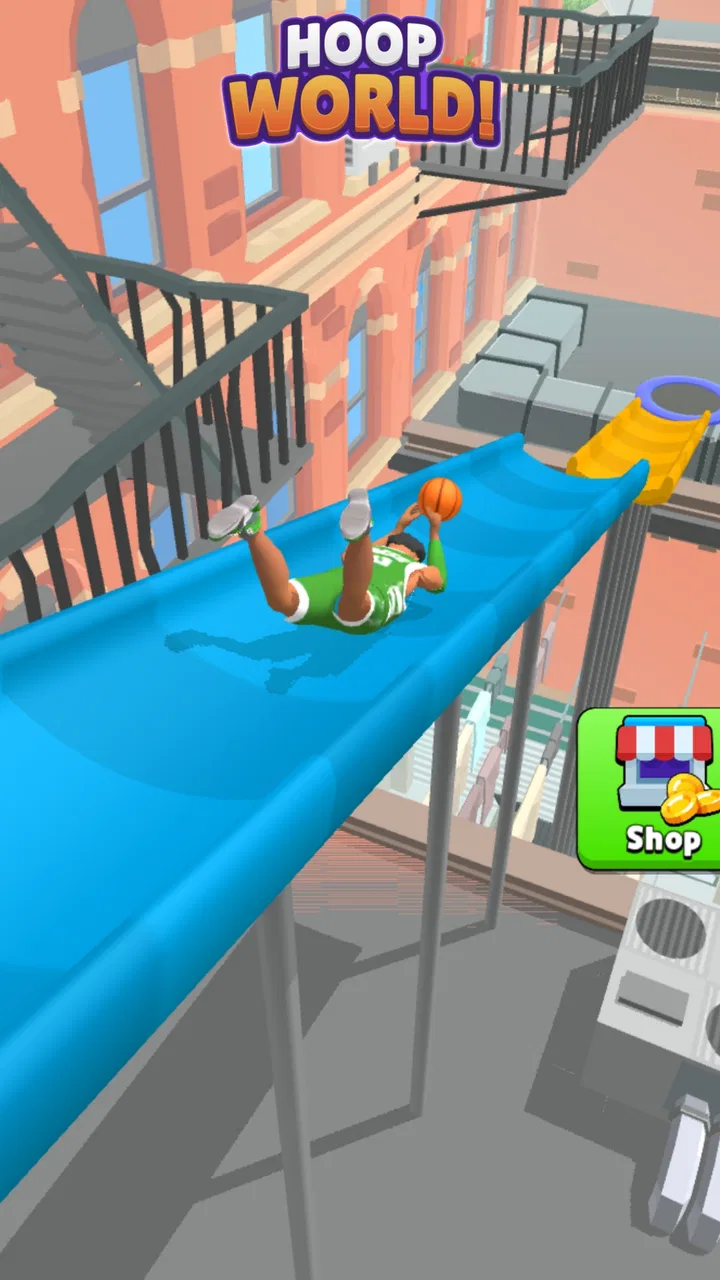
Hoop World: Flip Dunk Game 3D
- 4.7
- Rating
- 10.00M
- Installs
- Free
- Price

 Analysis by App-foxy
I approached Hoop World: Flip Dunk Game 3D expecting a quick basketball distraction, and that is exactly where it works best. This is a sports game from TapNation built around timing, movement, and the satisfaction of landing a clean dunk after passing through unusual portal-like setups. It is free to download, aimed at Everyone, and easy to understand within a few seconds, but it still has enough pressure in its later challenges to make a short session feel meaningful.
My first impression was that it is less about playing a full basketball match and more about solving a sequence of compact dunk attempts. You are not managing a team, building a career, or learning a deep set of plays. Instead, the focus stays on controlling a basketball player through a stylized obstacle course and trying to finish the move successfully. That narrow idea gives the game a clear identity, although it also means people looking for realistic basketball simulation should set their expectations differently.
How the dunk-focused gameplay feels in everyday play
The main appeal is the immediate loop: begin an attempt, read the arrangement in front of you, guide the movement, and try to finish with the ball through the hoop. The portal theme makes ordinary dunking feel more like a small spatial puzzle. A successful attempt is not only about reaching the basket; it is about understanding the route and committing to the right moment.
You May Also Like

 Google Keep - Notes and lists
Google Keep’s Quiet Growth Shows the Appeal of Simpler Notes
As mobile work gets busier, Google Keep keeps winning a simple contest: capture a thought quickly, find it later, and get on with the day.

 Blood Strike: 2.5 Anniversary
Blood Strike’s Loadouts Turn Every Drop Into a Tactical Gamble
A close look at Blood Strike’s custom loadouts: how fast access to signature weapons reshapes its battle royale rhythm, rewards preparation, and narrows the gap between fights.

 Pandora - Music & Podcasts
Pandora’s Music Is Easy to Start, but Harder to Recover
Pandora’s strength is its low-effort path from a seed to a station. Its weak spot is how much confidence it asks you to place in connection, setup, and quiet recovery.

 8 Ball Pool
 Is Built on Rivalries, Rematches, and Routine
A close look at the rivalries, rematches, shared routines, and unanswered safety questions that turn a quick pool match into a persistent mobile community.

 Samsung Music
’s Quiet Strength Is Playing What You Already Own
Its reach comes less from spectacle than from dependable access to a personal library. That simplicity is both the app’s strongest retention engine and its ceiling.

 AccuWeather: Weather Radar
AccuWeather Review: A Quick, Clear Forecast for Everyday Decisions
For everyday plans, the best forecast is the one you can understand quickly. AccuWeather makes rain timing, radar, and local conditions easy to act on, with a few trade-offs.
More From Our News Desk



I found the game most enjoyable in short bursts. It fits the kind of session where I have a few minutes while waiting for an appointment or taking a break from work. There is no need to remember a complicated storyline or prepare a long match. I can open it, make several attempts, and stop without feeling that I have abandoned a larger team or campaign.
That convenience comes with a trade-off. Because each challenge is concentrated around a simple action, mistakes become very noticeable. In a conventional basketball game, a missed shot is one event among many possessions. Here, the dunk is the whole point, so an awkward failure can feel more frustrating than its simplicity suggests. I had to treat each attempt as a timing exercise rather than expecting the game to carry me forward automatically.
Timing matters more than basketball knowledge
Players who already understand basketball will recognize the visual language of a hoop and a dunk, but advanced sports knowledge is not required. The useful skill is judging motion and reacting to the shape of the route. I paid more attention to where the player was in relation to the next opening than to traditional basketball ideas such as defensive spacing or shot selection.
A practical tip is to watch one complete attempt before rushing to repeat it. When a route includes portals or unusual changes in direction, the first failure can reveal more than a hurried second try. I learned to identify the point where my movement became irreversible, then adjust that moment instead of changing everything at once. This makes the game feel less random and gives each retry a clear purpose.
Another helpful habit is to separate navigation errors from finishing errors. Sometimes I reached the hoop badly; other times the route was fine but the final dunk did not line up. Treating those as different problems made progress easier. If I corrected the wrong part of the attempt, I often repeated the same mistake with more confidence rather than actually improving.
Progress creates pressure without becoming a full simulation
The game’s progression is built around repeated attempts and increasingly demanding situations rather than a detailed sports season. That structure is approachable, but it can also create a familiar mobile-game tension: the action is easy to start, while consistent success requires patience. The first few minutes invite casual play; later, the same basic idea asks for more accurate decisions.
This is where the game can divide players. If you enjoy retrying a compact challenge until the movement feels right, the pressure is motivating. If you prefer relaxed scoring with generous recovery, the repeated need to correct a failed dunk may become tiring. I would not recommend it to someone who dislikes trial-and-error design, even if they enjoy basketball as a subject.
For a realistic everyday scenario, I can imagine using it during a short commute when I want something more active than scrolling but less demanding than a full competitive game. I would not choose it for a long evening if I wanted variety in rules, teams, or match tactics. Its strength is concentrated interaction, not breadth.
The free entry point makes trying it straightforward. The game is listed as free, while optional purchases range from around two dollars and fifty cents to one hundred dollars per item. That is important context for anyone deciding how to approach it. I would begin with a strict no-spend plan, play long enough to understand the normal progression, and only then decide whether any optional purchase genuinely improves my experience.
I also would not treat the presence of purchases as proof that the game is unfair. The purchase range tells me that spending exists, but it does not by itself explain how purchases affect progress or whether they are necessary. A careful player should judge the game by what can be achieved without paying, rather than assuming either that every purchase is harmless or that the entire experience is blocked without one.
What spending changes in the decision to install
For families, the Everyone age rating makes the game broadly accessible, but that does not remove the need for sensible device controls. A child may understand the dunking quickly and still not understand the value of an optional purchase. I would check the device’s purchase protections before handing it over, especially because the listed price range includes both small and very large individual items.
For adults, the most useful question is whether the core loop remains enjoyable without spending. My recommendation is to play it as a timing game first, not as a shopping experience. If the retries themselves are satisfying, the free download has a clear purpose. If the only enjoyable part seems to be accelerating progress, I would skip purchases and reconsider whether this is the right game for me.
There is also a psychological trade-off in any retry-focused game. A difficult attempt can make an optional shortcut feel attractive, even when the player was close to solving the route through practice. I found it better to take a short break after several failures. Returning with a calmer view of the movement helped me decide whether I was stuck or simply rushing.
Fairness, competition, and what I would want to know before paying
Hoop World is not the kind of sports title I would choose for serious head-to-head competition. Its appeal comes from personal execution: can I read the route, control the movement, and complete the dunk? That makes the idea of competitive fairness different from a multiplayer basketball game. I am mainly comparing my own consistency against the challenge in front of me.
That distinction matters. In a traditional basketball alternative, fairness may involve team balance, online matchmaking, defensive mechanics, and the relationship between skill and player ratings. Here, the central fairness question is simpler: does success depend on learning the movement, or does spending become the dominant route forward? The available purchase information confirms optional items and their price range, but it does not establish a pay-to-win system or a competitive ranking structure, so I would avoid making stronger claims.
From my perspective, the game is fairest when I treat it as a self-contained arcade challenge. I am not expecting a simulation with transparent player statistics or an esports-style skill ladder. I am expecting a sequence of attempts where practice should improve my timing. That expectation fits the design much better than comparing it directly with a full basketball simulator.
There is a useful way to test this for yourself. Play several sessions without purchasing anything and notice what kind of progress you are making. Are failures becoming easier to diagnose? Are you improving your route choice? Do you feel that another attempt could solve the problem? Those answers tell you more about the game’s practical fairness for your play style than the existence of a purchase button.
I would also keep the game separate from competitive sports apps that focus on real teams, live results, or strategic roster management. Those alternatives are better if you want basketball context beyond the dunk itself. A physics-heavy basketball game may also suit you more if you want to experiment with shots, rebounds, and positioning. Hoop World is the better fit when you want a compact, visually unusual challenge with almost no preparation.
Small techniques that make retries less wasteful
My most useful technique was to change only one input decision per retry. If I altered the initial movement, the direction near a portal, and the final approach all at once, I could not tell what helped. Keeping two parts consistent made the result easier to read. This is a simple method, but it turns repetition into practice instead of guesswork.
I also found value in playing with a clear stopping point. For example, I might stop after a successful completion rather than continuing until frustration replaces the satisfaction. That protects the game’s strongest quality: it is easy to pick up and put down. Long sessions can make a small mistake feel bigger than it is.
When introducing the game to another person, I would explain the goal without giving them a detailed strategy. The fun comes from discovering how the route behaves. A quick demonstration can show the basic interaction, but solving the first awkward portal arrangement independently gives the game more personality.
Version, device expectations, and the practical download decision
The current version is 1.98, and the game runs on Android 7.0 or later. That makes it relevant to people using older compatible Android devices, although actual comfort will still depend on the phone or tablet and how smoothly it handles the game. I would install it on the device where I normally play short arcade titles, then pay attention to control responsiveness before judging the difficulty.
The game has been available since October 25, 2021, and its broad audience is reflected in its popularity: it has passed ten million installs, with an average rating of 4.7 from around fifty-five thousand ratings and roughly one thousand two hundred written reviews. Those figures suggest that many players find the basic idea appealing, but they do not replace personal testing. A high average cannot tell me whether I will enjoy repeated timing challenges, and a large install count cannot guarantee that the purchase approach suits my preferences.
I would especially consider the game for someone who wants basketball flavor without the commitment of a full match. It is also a reasonable choice for players who like visual obstacles, short retries, and the satisfaction of gradually improving a movement. I would skip it if my priority is realism, deep tactics, online competition, or a broad collection of basketball modes.
Another reason to hesitate is that the compact concept may eventually feel repetitive to players who need constant mechanical variety. The portal-based dunk idea is distinctive, but the game remains centered on that one kind of action. I would not download it expecting a complete replacement for a console-style basketball game.
The questions I would settle before recommending it
If you are wondering whether it is suitable for a quick casual session, my answer is yes. The controls and objective are easy to grasp, and the attempt-based structure does not demand a large time commitment. The harder question is whether you enjoy repeating a challenge after a near miss. That is the point where the game’s appeal becomes personal rather than universal.
If you are asking whether you must pay to understand the game, I would start without spending. The title is free, and optional purchases are clearly part of the model, but the available information does not establish that payment is required for normal play. Keeping purchases disabled at first is the most sensible way to evaluate the core experience.
If you want to know whether it is a serious basketball game, I would say no in the traditional sense. It uses basketball as the foundation for an arcade obstacle experience. You will practice timing and route reading more than offensive systems, defense, or team strategy.
If you are choosing between this and a standard sports alternative, choose this one for short, self-contained dunk challenges. Choose the alternative if you want matches, rosters, realistic rules, or a stronger sense of long-term athletic progression. The comparison is not really about which game is better overall; it is about whether you want a basketball activity or a basketball-themed timing puzzle.
Finally, if you are concerned about spending, I would make the decision before opening the game: either play entirely for free or set a firm personal limit. The individual purchase range reaches from around two dollars and fifty cents to one hundred dollars, so casual curiosity should not turn into an unplanned expense. That is not a judgment about the developer; it is simply a sensible boundary for a free game with optional purchases.
My trust verdict after weighing the whole experience
TapNation has made a focused game rather than an overloaded one. The portal-driven dunk format gives Hoop World a recognizable hook, and I appreciate that it can be understood immediately while still rewarding more careful timing. Its best moments come when I stop treating a failed attempt as bad luck and start reading it as information about the route.
My reservations are equally clear. The experience may become repetitive for players who need several sports modes, and the purchase range means families and cautious spenders should use device safeguards. I also would not present it as a competitive basketball benchmark, because its strengths are arcade control and personal improvement rather than team balance or simulation depth.
My recommendation is to try it as a free, short-session timing game, not as a complete basketball replacement. If you enjoy portal puzzles, repeated dunk attempts, and small improvements that come from better timing, it is an easy game to keep nearby. If you want realism, deep strategy, or a clearly documented competitive economy, another sports title will probably serve you better.
For me, that honest positioning is what makes the download worthwhile. I can open it for a few minutes, focus on one route, and leave after a satisfying finish. I would keep spending optional, judge progress by my own control rather than by pressure, and recommend it most strongly to anyone who wants basketball style distilled into quick, playful challenges.
FAQs for Hoop World: Flip Dunk Game 3D
01What is Hoop World: Flip Dunk Game 3D?
Hoop World: Flip Dunk Game 3D is a dynamic and engaging mobile game where players perform acrobatic flips and slam dunks in a vibrant 3D environment. The game combines elements of sports and arcade gameplay, offering a unique experience that challenges players to master complex tricks and compete for high scores.
02What are the main features of Hoop World: Flip Dunk Game 3D?
The game features intuitive controls, allowing players to easily execute flips and dunks. It offers a variety of levels with increasing difficulty, each with unique challenges and obstacles. Players can customize their characters and unlock new moves as they progress. The game also includes leaderboards for competitive play.
03Is Hoop World: Flip Dunk Game 3D free to play?
Hoop World: Flip Dunk Game 3D is free to download and play, offering in-app purchases for players who wish to enhance their gaming experience. These purchases might include cosmetic items, new character skins, and special moves. While in-app purchases can enhance gameplay, they are not necessary to enjoy or complete the game.
04What platforms support Hoop World: Flip Dunk Game 3D?
Hoop World: Flip Dunk Game 3D is available on both Android and iOS platforms. Players can download the game from the Google Play Store for Android devices and the Apple App Store for iOS devices. Ensure your device meets the minimum system requirements for optimal performance.
05Does Hoop World: Flip Dunk Game 3D require an internet connection?
While Hoop World: Flip Dunk Game 3D can be played offline, an internet connection is required for certain features. Online connectivity allows access to leaderboards, updates, and multiplayer modes where players can compete against others worldwide. Offline mode allows for uninterrupted gameplay without these online features.
Pros
- Engaging physics-based gameplay.
- Bright
- colorful graphics.
- Easy to pick up and play.
- Variety of challenging levels.
- Smooth controls enhance experience.
Cons
- Ads can be intrusive.
- Limited customization options.
- Occasional lag on older devices.
- Repetitive background music.
- In-app purchases can be pricey.

Hoop World: Flip Dunk Game 3D
Gallery